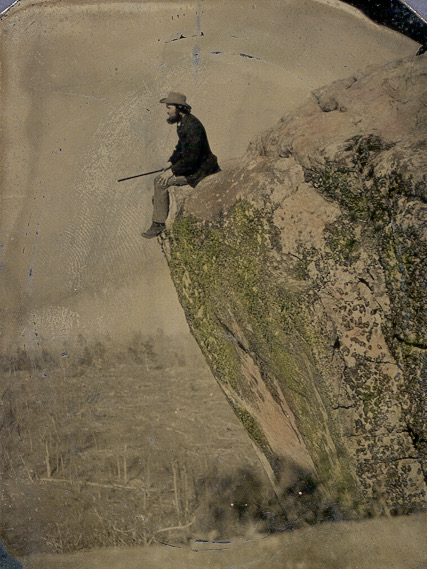
Meet Jacob. Jacob is my 5th Great Grandfather’s Nephew. This is a photograph he had taken in December of 1864 as a Christmas gift for his wife. Just a few weeks prior to this photo, he was charging with his fellow warriors up the ridge he’s sitting on in the Union Army’s breakout from the Confederate siege of Chattanooga, Tennessee, A couple of months prior to that, at Chickamauga, he had received a facial wound from rifled musket. He sits in profile in this photo, his wound concealed by the camera angle.
Jacob was a semi-educated farmer from South Central Ohio. He was also a prolific letter writer. Fortunately, my family saved his war correspondence to his wife through the generations – I have hundreds of his letters to Mary stretching from 1862-1865. He spent 189 days under direct fire through his years in the western theater of the Civil War, culminating in Sherman’s March to the Sea and the Grand Review in Washington, DC. Jacob survived the war and came home to his wife and kids and lived a long and fruitful life.
My family has a legacy of Military Service. I entered the Air Force expecting to deploy. My first set of deployment orders dropped in 2012 – it was CENTCOM tasking, but I was shocked when I saw the location: Dover, Delaware.
Dover is the home of Air Force Mortuary Affairs.There is a cost to war – I’ve seen it. I’ve felt it. One day in the mortuary, after receiving yet another C-17 with flag draped transfer cases containing the remains of our nation’s fallen, I experienced something particularly visually disturbing. A fellow deployer looked at me and said, “I just felt something go in me, and someday it will come out.” He was right.
Public Affairs Video, March 2021
Because of the nature of that deployment, we were very intentional about self-care, but there were way too many disturbing experiences to fully handle while continuing to make the mission happen. So, we continued to provide stellar care to both our Fallen Warriors and their families who visited to watch the Dignified Transfer ceremony, knowing that full integration of our experiences at the mortuary would have to come later.
I was a different man when I returned to my home station. Some of the changes were good – after so many visible reminders of mortality – I learned to squeeze my wife and kids tighter – to embrace every opportunity to live life with joy. I played more games with my children than I ever did before.
Other changes were so subtle that I wasn’t aware of them for years.
***
Buzzard’s Roost wasn’t much of a battle in the scope of the larger war – but one of Jacob’s most significant days in the war. The Army of the Cumberland was moving towards Atlanta, and they had to take the gap at Buzzard’s Roost to do so. In his fairly new role as Regimental Color Sergeant, Jacob would have no weapon. He would lead the charge with nothing more than the regimental flag in his hands – He was the visual cue for all verbal commands.
His regiment advanced and successfully pushed the Confederate skirmishers down a valley and back up the next ridge. However, when they reached the next ridge, they found themselves facing an entire division of Confederate troops dug into defensive works – they did the only they a regiment could do under those circumstances – they turned around and began to run back to where they started.
As they were running for their lives, Jacob began to lag behind. He was gassed. He fell down behind a log and huddled up was bullets whizzed past. Major Jolly looked back and saw him and shouted, “For God’s sake, Jake, get up and come on. We can’t come back and get you.” Jacob got up. In his letter to Mary he wrote, “So, I got up and walked, because a I could not run, a single target for all to shoot at.” He made it back to the safety of the lines with a bullet hole through the flagpole and another through the flag, but he was unscathed.
***
When I came home from the mortuary, I threw myself into my work. Busyness can be as destructive as substance abuse when used as an unfettered coping mechanism. But the AF rewards hard work. In the years following Dover, I received all sorts of cool recognitions and my career began to look bright – but, all was not well within me. I refused to admit that there was any lasting fallout from my experiences at the mortuary.
In 2017, some of the “stuff” that went in at Dover began to come out. The specifics are outside of the scope of this talk, but the bottom line is – I had to work through my experiences with someone, and I did. I raised my hand, took a knee, and talked through my pain. My caregiver was a psychological ninja, who told me things I didn’t want to hear and deftly moved past my defenses to strike at the heart of my issues. She helped point me in the direction of hope and healing.
***
In late 1864, Jacob watched his cousin and friend, Levi Hennis, die. Levi was shot in the head outside of Atlanta. The bullet entered above his jaw and lodged in the back of his head. Levi’s last word was “Oh!”
Jacob used his authority to organize a quick battlefield burial. It wasn’t a safe place for a burial – a spent round hit the chaplain’s boot as he was presiding over the committal. Jacob was deeply effected by Levi’s death.
Of course, Jacob had buried many friends and acquaintances by this time in the war, but something in him was beginning to change. The bravado of his earlier letters to Mary was replaced by expressions of his own mortality and a crisis of faith. By this time in the war, he almost always signed his letters to Mary with the note, “Yours until death.”
Shortly after Levi died, Jacob wrote a letter to a former Army chaplain with whom he had a prior connection, looking for hope and guidance. The letter he wrote to the chaplain didn’t survive, but I have the chaplain’s letter of response. Jacob saved the letter, forwarded it to Mary, and wrote on the bottom, “I hope to follow his advice.” He received the hope and guidance he was looking for.
***
I began transcribing Jacob’s letters about the same time I began to see a professional caregiver and I found Jacob’s letters to be as helpful as my sessions with my counselor. I could identify with my ancestor as he curled up behind a log, feeling he didn’t have the strength to stand – and I found the courage to stand and walk forward with honesty about my brokenness that gave me a new and deeper empathy towards those around me who were hurting.
It’s amazing how many people around you, right now, are huddled behind a log – feeling hopeless, who don’t know how to stand or where to move. They’re frozen by the exhaustion to the battlefield they’ve just traversed and they need a voice. They need someone to speak – to say, “For God’s sake, Jake, get up and come on…”
Major Jolly wasn’t a professional caregiver, in fact, hardly anyone in the regiment liked him, including Jacob. But he saw a need and spoke into Jake’s life – the exact words he needed at the exact time he needed them.
Words matter. Look around you. Major Jolly spoke words of hope to Jacob. And 156 years later, Jacob is still speaking to me. Someone needs to hear words of hope from you. Open your mouth – speak hope and life. Sure, guide people towards professionals. Docs and Chaplains are ready to bring their formidable arsenal of care to the fight in the lives of the hurting, but you don’t need a degree to give an encouraging word and to show real interest in the lives of your coworkers and friends.
By the way, I’m a Chaplain. I am a professional care-giver. It’s my job to bring hope and healing. It’s my job to speak life. But I will contend – it’s your job too! Feel free to bring your hurts to me and others like me. Please do point others our way, but please….please, don’t dodge the opportunities you have all around you to speak hope and life into people you see huddled behind logs! Don’t underestimate the power of well-timed words of encouragement.
 A Thousand Thunders